Math is one of the hardest subjects for students—not because it’s impossible, but because everything builds on itself. If you misunderstand one concept or make a small mistake early in a problem, the entire solution can break. Unlike subjects where you can partially get credit for explanations, math requires precision, logic, and step-by-step reasoning.
Another challenge is the lack of instant help. When you’re stuck on a derivative, an integral, or even a tricky algebra problem, it’s not always easy to figure out where you went wrong. That’s where AI tools for math have completely changed the game.
The best AI tools today don’t just give answers—they walk you through problems step-by-step, explain the reasoning behind each step, help you debug mistakes, and even visualize equations through graphs. Whether you’re working through calculus, algebra, statistics, or engineering math, AI can act like a 24/7 tutor that adapts to how you learn.

Why AI Tools for Math Are Different
Math is fundamentally different from other subjects. It’s not about writing well or memorizing facts—it’s about following a logical sequence of steps where each move depends on the previous one. This means a single mistake—like dropping a negative sign or applying the wrong rule—can completely derail your answer.
That’s why traditional studying methods can fall short. If you only see the final answer, you don’t know where your reasoning broke down. What makes AI tools powerful is their ability to expose the process.
For example, if you’re solving a derivative like
f(x) = (3x² + 2x)^5, a strong AI tool will:
- Identify that the chain rule is required
- Differentiate the outer function first
- Multiply by the derivative of the inner function
- Show each transformation step clearly
This kind of breakdown helps you understand not just what to do, but why each step happens.
AI also gives instant feedback. Instead of waiting for office hours or solutions to be posted, you can immediately check your work, compare steps, and fix mistakes while the concept is still fresh in your mind.
Another major advantage is visualization. Graphing functions, understanding limits, or interpreting statistical distributions becomes much easier when you can see how equations behave instead of just working with symbols.
For a broader look at AI across academics, check out Best AI Tools for Students (2026).
Best AI Tools for Math
1. Wolfram Alpha
What it does:
Wolfram Alpha is one of the most powerful tools for math, especially for advanced topics like calculus, linear algebra, and engineering equations. It’s built for computation, not conversation, which makes it extremely precise.
Step-by-step solving:
It can break down derivatives, integrals, limits, and even differential equations step-by-step (with Pro features).
Real student scenarios:
- Solving ∫ x²e^x dx using integration by parts with each step shown
- Finding eigenvalues of a matrix in linear algebra
- Computing limits like lim (x→0) (sin x / x) and explaining the result
Best for:
Calculus, engineering math, symbolic computation.
Limitations:
Interface can feel less intuitive, and full step explanations may require a subscription.
2. ChatGPT
What it does:
ChatGPT acts like a personalized math tutor that explains concepts in plain English while solving problems step-by-step.
Step-by-step solving:
Strong at breaking down algebra, calculus, and even statistics problems while explaining reasoning.
Real student scenarios:
- Asking: “Explain how to solve this derivative step-by-step” and getting a full chain rule walkthrough
- Debugging a wrong answer by comparing your steps to the correct process
- Solving probability problems and explaining distributions
For example, if you’re working on a derivative like (x² + 1)(x³), ChatGPT can walk through the product rule step-by-step and explain why each term appears in the final answer.
Best for:
Understanding concepts, debugging mistakes, learning reasoning.
Limitations:
Can occasionally make calculation mistakes—best used alongside another tool for verification.
If you’re also using AI for organizing notes and concepts, check out Best AI Note-Taking Tools for Students (2026).
3. Photomath
What it does:
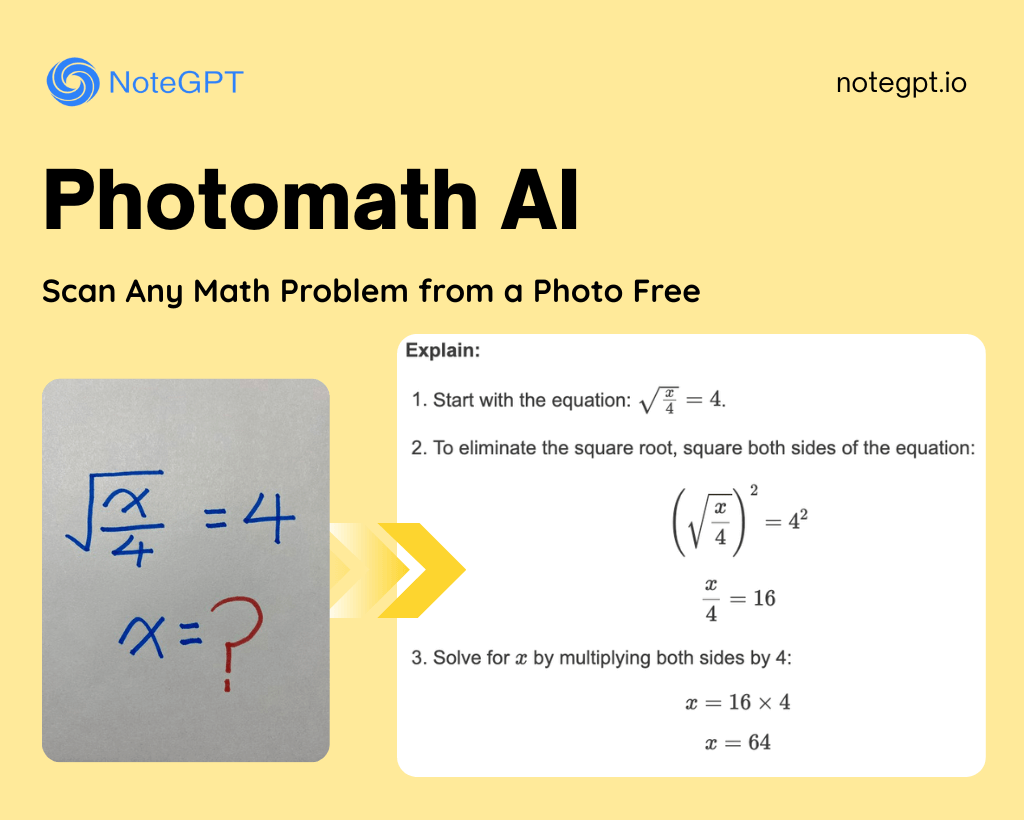
Photomath allows you to scan handwritten or printed math problems using your phone and instantly get solutions.
Step-by-step solving:
Provides visual step-by-step breakdowns, especially for algebra and basic calculus.
Real student scenarios:
- Scanning a handwritten quadratic equation and seeing it solved step-by-step
- Checking homework answers quickly before submitting
- Breaking down fractions or simplifying expressions visually
Best for:
Algebra, quick homework checks, handwritten problems.
Limitations:
Less effective for higher-level math like multivariable calculus or advanced proofs.
4. Symbolab
What it does:
Symbolab is built specifically for step-by-step math solving, making it ideal for learning processes rather than just getting answers.
Step-by-step solving:
Extremely detailed—great for derivatives, integrals, and algebraic manipulation.
Real student scenarios:
- Solving systems of equations step-by-step
- Breaking down derivatives using product, quotient, or chain rules
- Understanding each algebraic transformation clearly
For example, if you input a system like:
2x + y = 5
x – y = 1
Symbolab will show each elimination or substitution step clearly.
Best for:
Learning structured problem-solving in algebra and calculus.
Limitations:
Full steps often require a paid version. If you’re looking for AI tools on a budget, make sure to take a look at Best Free AI Tools for Students (2026).
5. Microsoft Math Solver
What it does:
A free, well-rounded tool that combines scanning, solving, and graphing into one platform.
Step-by-step solving:
Provides explanations along with graphs and alternative solving methods.
Real student scenarios:
- Solving a function and instantly seeing its graph
- Comparing different ways to solve the same equation
- Understanding how changing variables affects a graph
For example, if you input y = x² – 4x + 3, it will graph the parabola and show intercepts, helping you connect algebra to visualization.
Best for:
Visualization, quick problem solving, beginner to intermediate math.
Limitations:
Not as deep as Wolfram Alpha for advanced topics.
How to Choose the Right AI Tool for Math
Choosing the right AI tool depends on what you’re trying to do.
If your goal is to learn, you should prioritize tools that show step-by-step reasoning like Symbolab or ChatGPT. These help you understand the process, not just the answer.
If you need accuracy and advanced computation, Wolfram Alpha is the best choice. It handles complex equations that other tools might struggle with.
If you’re a visual learner, tools with graphing features like Microsoft Math Solver can make abstract concepts much easier to understand.
If you’re working with handwritten problems, scanning tools like Photomath are the most convenient.
A good strategy is to combine tools:
- Use ChatGPT to understand concepts
- Use Symbolab for structured steps
- Use Wolfram Alpha to verify answers
This layered approach reduces mistakes and strengthens understanding.
To build a complete study system around these tools, check out Best AI Tools for Studying (2026).
Tips for Using AI for Math

AI can dramatically improve your math skills—but only if you use it intentionally.
First, always attempt the problem yourself before using AI. This forces your brain to engage with the concept instead of passively consuming answers.
Second, ask AI why, not just what. Instead of asking “What’s the answer?”, ask “Why is this step done this way?” or “What rule is being applied here?”
Third, turn AI solutions into notes. Writing down steps in your own words helps reinforce learning and builds long-term understanding.
Fourth, use multiple tools to cross-check answers. If two tools agree, you’re more likely to be correct.
Finally, avoid over-reliance. AI should support your learning—not replace it. The goal is to improve your problem-solving ability so you can perform well without assistance during exams.
Study Tools That Pair Well With AI
Graph paper notebook
Helps you organize work neatly, sketch graphs, and follow step-by-step solutions alongside AI explanations.
Scientific calculator
Essential for quick calculations and exams where AI tools aren’t allowed.
Desk lamp
A good desk lamp improves focus during long problem-solving sessions and reduces eye strain when working through detailed equations or graphs.
FAQ
Can AI actually help you understand math concepts long-term, or just give answers?
AI can absolutely help you understand math long-term—but only if you actively engage with the explanations. The best tools break problems into steps and explain the reasoning behind each move, which helps build conceptual understanding. However, if you just read the solution without thinking through it, you won’t retain much. Treat AI like a tutor, not a shortcut, and you’ll see real improvement over time.
What’s the best way to use AI for difficult topics like calculus or linear algebra?
For advanced topics, the most effective approach is to combine tools. Start by attempting the problem yourself, then use AI to walk through the correct method step-by-step. Ask follow-up questions like “why was this rule used here?” or “what would happen if this term changed?” This deeper interaction helps you understand concepts like the chain rule, eigenvalues, or integrals instead of just memorizing procedures.
How accurate are AI math tools, and should you trust them completely?
Most AI math tools are highly accurate, especially for structured problems like algebra or calculus, but they are not perfect. Errors can happen—especially with more complex or ambiguous inputs. That’s why it’s important to cross-check answers using multiple tools or verify key steps yourself. Think of AI as a strong assistant, not a final authority.
Can AI handle word problems and applied math correctly?
AI tools can solve many word problems, but accuracy depends heavily on how clearly the problem is written. If the wording is vague or missing context, the AI may misinterpret the scenario. A good strategy is to rewrite the problem in a clear, structured way before inputting it, and then verify that the interpretation matches the original question.
Conclusion
Math is ultimately about building problem-solving skills, not just arriving at the correct answer. The challenge for most students isn’t effort—it’s getting stuck without understanding why something works. That’s exactly where AI tools create the biggest advantage.
The best AI tools for math in 2026 go far beyond basic calculators. They break down complex problems into clear steps, explain the reasoning behind each decision, and allow you to visualize concepts that would otherwise feel abstract. Whether you’re working through algebra, calculus, statistics, or engineering math, these tools can dramatically reduce frustration and accelerate learning.
However, the real value comes from how you use them. Students who rely on AI just for answers often struggle later when they face exams or more advanced material. On the other hand, students who use AI to understand steps, ask deeper questions, and reinforce concepts build a much stronger foundation.
If you treat AI like a tutor—something you interact with, question, and learn from—it can become one of the most powerful tools in your academic toolkit. It helps you identify mistakes faster, develop intuition for problem-solving, and gain confidence in tackling difficult topics.
In the long run, success in math isn’t about speed or shortcuts. It’s about clarity, consistency, and understanding. AI simply gives you a faster path to get there—if you use it the right way.
1 thought on “Best AI Tools for Math (2026)”