
You sit down to study and immediately feel behind.
Too many lectures. Too many slides. Too much content—and not enough time to actually understand it all.
So you try to move faster.
- you skim instead of fully reading
- you rush through notes
- maybe you start using AI tools to speed things up
…but it still takes hours just to feel somewhat prepared.
That’s the frustrating part.
Most students aren’t slow because they lack discipline—they’re slow because their methods create unnecessary work. And even when they use AI, they don’t use it in a way that actually saves time.
If you’re trying to figure out how to study faster using AI, this isn’t about shortcuts or cutting corners.
It’s about removing wasted effort so you can:
- focus only on what actually matters
- understand faster
- practice sooner
Quick Answer
Students study faster using AI by:
- Getting clarity immediately instead of staying stuck on confusion
- Skipping low-value tasks like rewriting notes and reorganizing information unnecessarily
- Turning learning into active recall as quickly as possible instead of delaying practice
- Focusing on weak areas instead of reviewing everything evenly across all topics
AI doesn’t replace studying — it compresses it into higher-value, more efficient work over time.
Why Most Students Stay Slow
Most students don’t realize how much time they’re wasting while studying.
The issue isn’t effort—it’s that a lot of common study habits feel productive but don’t actually improve understanding efficiently. You can spend hours rereading notes or rewriting summaries without making meaningful progress.
AI doesn’t automatically fix this either.
If you use it the same way—passively—you just end up doing the same inefficient work faster, not better. This is exactly how students fall into relying on AI without actually improving, which is something I break down more in How to Use AI Without Getting Lazy (2026).
Where students actually lose time:
- Over-reading instead of processing
→ going through the same material without testing understanding - Passive learning habits
→ highlighting, watching, summarizing without recall - Rewriting notes instead of using them
→ organizing information instead of applying it - No prioritization
→ treating all topics as equally important - Using AI for answers instead of understanding
→ skipping the thinking process entirely
The key shift: AI should improve how you think, not replace it.
Real Ways to Study Faster Using AI
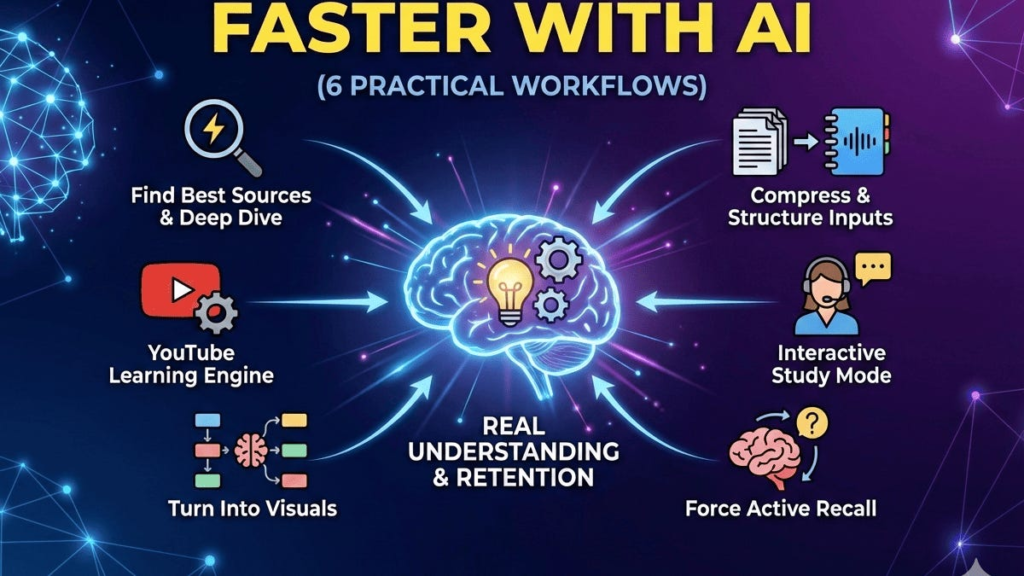
This is where the real difference happens.
Most students use AI, but very few use it in a way that actually saves time. The difference isn’t the tool—it’s how you apply it to eliminate the slowest parts of studying.
Think of this as one system:
remove friction → understand faster → practice immediately → focus only where needed
If you apply these correctly, your study sessions become shorter, more focused, and significantly more effective.
1. Fix Understanding Immediately Instead of Rewatching Lectures
One of the biggest time-wasters is going back through lectures or slides trying to understand something that didn’t click the first time.
This is slow because you’re relying on the same explanation that already failed once. You reread, rewatch, and hope it eventually makes sense—but that process is inefficient.
Instead, use ChatGPT or Claude to immediately resolve confusion.
Take your notes and ask for:
- simpler explanations
- step-by-step breakdowns
- analogies that relate to things you already understand
- alternative explanations from different angles
This changes the entire pace of your studying.
Instead of spending 30–60 minutes stuck on one concept, you resolve it in a few minutes and keep moving.
How to apply this properly:
- Don’t reread first → clarify first
- Don’t “try harder” → get a better explanation
- Don’t stay stuck → iterate until it clicks
👉 You’re not skipping learning—you’re skipping the inefficient part of learning
2. Convert Everything Into Practice Immediately: Biggest Speed Gain
The biggest gap in most study routines is the delay between learning and testing.
Students usually:
- read first
- review later
- test (if they even do) at the end
This creates a slow feedback loop where you don’t actually know what you understand until much later. By then, you’ve already spent too much time passively going through material.
AI removes that delay completely.
Right after studying something, you can instantly turn it into:
- practice questions
- flashcards
- exam-style problems
- “test me” prompts
using tools like Quizlet or directly inside AI tools like ChatGPT.
This changes your entire study flow:
- instead of rereading → you test immediately
- instead of preparing to study → you’re already studying
- instead of passive → fully active
How to actually use this well:
- generate questions right after each topic (don’t wait)
- mix basic recall with harder application questions
- re-test yourself instead of going back to notes
- use strong, specific prompts to get better questions and explanations (if you want ready-to-use ones, check out Best ChatGPT Prompts for Students (2026) — it’ll make this way faster)
👉 This is where most of your speed gains come from — you remove the delay between learning and practicing entirely
3. Stop Studying Everything: Target Only Weak Areas
One of the biggest inefficiencies in studying is reviewing everything evenly.
You don’t need to spend equal time on every topic—but most students do because they don’t know what to skip.
AI helps you identify weak areas instantly and adjust your study time accordingly.
Instead of guessing what to review, you:
- quiz yourself without hints
- track where you struggle
- isolate weak topics
- spend most of your time there
This completely changes your time distribution.
Instead of:
- 3–4 hours reviewing everything
you get:
- 1–2 hours focused on what actually needs work
How to apply this:
- Ask AI to test you aggressively (no hints)
- Keep track of mistakes, not what you got right
- Revisit weak topics multiple times
👉 Efficiency comes from what you don’t study
4. Eliminate Note-Rewriting Completely: Hidden Time Killer
Rewriting notes is one of the most common study habits—and one of the biggest wastes of time.
It feels productive because you’re actively doing something, but it doesn’t significantly improve retention compared to active recall.
AI allows you to remove this step entirely.

Instead of rewriting:
- Clean and structure your notes once
- Use AI to summarize or organize them
- Move directly into practice and recall
Better approach:
- Convert messy notes into clean summaries
- Highlight only key ideas
- Use notes as a reference, not a task
What this changes:
- Less time organizing
- More time applying
- Faster progression through material
👉 Removing this habit alone can save hours every week
5. Break Through Difficult Concepts Faster
Every subject has concepts that slow you down completely.
Normally, you:
- reread
- search online
- try to brute-force understanding
and this kills your momentum.
AI gives you something new: instant variation in explanation.
You can:
- ask for analogies
- request simpler versions
- break concepts into smaller steps
- compare multiple explanations
This removes one of the biggest bottlenecks in studying.
How to use this effectively:
- Don’t accept the first explanation if it doesn’t click
- Ask for a different perspective immediately
- Build understanding layer by layer
👉 You don’t get stuck anymore—you iterate until it makes sense
Tools Students Actually Use
Most students overcomplicate this part.
They think they need a stack of 10 different tools to study efficiently, when in reality, a few tools used properly will outperform everything else. The difference isn’t in the tool—it’s in how intentionally you use it within your study process.
Each of these tools solves a specific bottleneck in studying. When used correctly, they remove friction and speed up your workflow without making things more complicated.
- ChatGPT → fast explanations + instant practice generation
→ used when you’re confused, stuck, or need questions immediately
→ best for turning notes into active recall quickly - Claude → deeper explanations + better reasoning clarity
→ used when concepts are complex or layered
→ better for breaking down difficult topics step-by-step - Quizlet → review + spaced repetition
→ used after generating flashcards or questions
→ helps reinforce memory efficiently over time - Notion → organization + structure
→ used to track topics, weak areas, and study progress
→ keeps everything clean so you don’t waste time figuring out what to do next
The key is not to use all of them at once—it’s to use each one for its purpose. When each tool has a clear role, your studying becomes faster without becoming messy.
Study Setup That Actually Makes You Faster
Most students focus only on what they study, but ignore how their setup affects how quickly they can move through material.
The reality is, your environment and tools directly impact how long you can stay focused and how efficiently you study. If you’re constantly deciding what to do next, losing track of time, or slowing down on basic tasks, your study sessions become longer than they need to be.
You don’t need anything complicated, but a few small tools can make your studying noticeably more structured and efficient.
- Sticky note study planner →
Helps you quickly map out what topics to cover so you’re not wasting time figuring out what to study next. It keeps your sessions focused on high-priority tasks and reduces decision fatigue. - Pomodoro timer →
Structures your study into focused blocks so you stay consistent. It prevents burnout from overly long sessions and keeps you moving instead of dragging through material. - Scientific calculator →
Speeds up problem-solving for math-heavy subjects by reducing time spent on manual calculations, letting you focus more on understanding.
What this actually changes:
- less time wasted deciding what to do next
- more structured and efficient study sessions
- faster progression through material
These aren’t “study hacks”—they just remove small inefficiencies that add up over time.
Common Mistakes That Make You Slower
Trying to study faster can easily backfire if you misunderstand what “faster” actually means.
The goal isn’t to rush through material—it’s to remove wasted effort while keeping understanding high. Most mistakes happen when students focus on speed alone and ignore how learning actually works.

The result is usually worse performance despite spending less time.
Here are the most common ways students unintentionally slow themselves down:
- Rushing through content without understanding
→ feels efficient in the moment, but forces you to relearn everything later - Skipping difficult concepts entirely
→ avoids short-term friction but creates long-term gaps - Letting AI do all the thinking
→ removes the mental effort needed to actually learn - Switching tools constantly
→ wastes time setting up instead of studying - Focusing on time instead of results
→ finishing faster doesn’t matter if you don’t retain anything
What efficient studying actually feels like:
- more focused, not rushed
- more intentional, not random
- more mentally engaged, not passive
If it feels chaotic or rushed, you’re not studying faster—you’re studying worse.
FAQ
How do I actually know if AI is helping me study faster?
You’ll notice it in how your sessions feel. You’ll spend less time stuck, move through topics more smoothly, and need fewer repetitions to understand things. It’s less about time on the clock and more about how efficiently you’re progressing.
What’s the best way to combine AI with active recall?
Use AI to generate the questions, not the answers. Study by testing yourself first, then use AI to check, correct, and expand your understanding. That way, you keep the learning process active.
Is it bad to rely on AI for explanations?
No—as long as you’re still thinking. AI is great for explaining things, but you should always process the explanation yourself and be able to restate it in your own words.
What’s the biggest mindset shift for studying faster?
Stop trying to “get through everything.” Start focusing on understanding what actually matters and cutting out everything that doesn’t contribute to that.
Conclusion
Learning how to study faster using AI isn’t about doing less—it’s about removing what doesn’t matter.
Once you stop wasting time on passive habits, fix confusion immediately, and focus only on high-value work, everything changes. Studying becomes more direct, more focused, and significantly more efficient.
You don’t feel like you’re rushing—you feel like you’re moving with purpose.
That’s the difference between:
- studying longer
vs - studying smarter
AI doesn’t replace effort.
It makes your effort count more.
And when you use it properly, you won’t just save time—you’ll actually learn better in the process.
1 thought on “How to Study Faster Using AI (2026) | Save Time Without Cutting Corners”